A UX Case Study for the State of Idaho
Redesigning a State Government Platform for Clarity and Accessibility
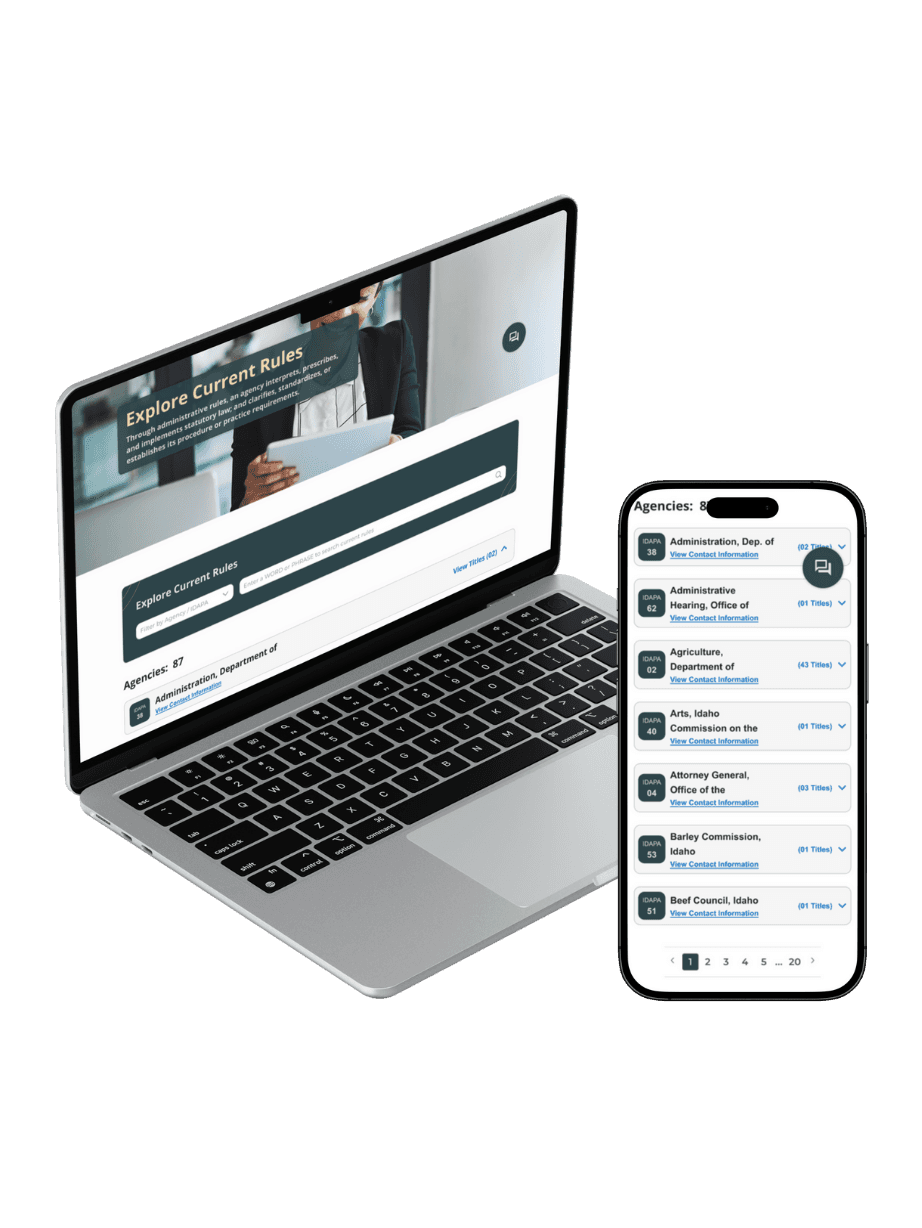
Responsive Web Platform
|
Public Sector (B2B2C)
|
Nov 2024 - May 2025
I converted this 👇
I converted this 👇
To this 👇
To this 👇
My Role and Leadership
As the Lead Product Designer, I owned the end-to-end strategy and execution. Beyond the UI, my primary responsibility was Stakeholder Management, bridging the gap between the Division of Financial Management's legal requirements and the public's need for simplicity. I facilitated alignment workshops to define MVP features and established a developer-handoff framework in Azure DevOps to ensure high-fidelity implementation.
About the project
This project, for me, was about cutting through complexity and redesigning an outdated legal website into something people could navigate with confidence.
Tools Used





How do we simplify a highly regulated, legally complex system, without oversimplifying the law or adding new maintenance burden?
The PROBLEM
The site had become a blocker rather than a resource.
From a user perspective, finding a single rule often meant navigating through long lists of links, jumping between pages, and manually piecing together context from multiple documents.
From an internal perspective, the DFM team struggled to update and manage content. Simple changes required extra effort, slowing response times and increasing the risk of outdated information remaining live.
SOLUTION
Visual Clarity
Visual Clarity
Better Navigation
Better Navigation
Consistent Elements
Consistent Elements
Improved User Flow
Improved User Flow
Improved IA
Improved IA
Usability-Ready Prototype
Usability-Ready Prototype
Developer-Friendly Design System
Developer-Friendly Design System
Cross-Team Collaboration
Cross-Team Collaboration
Business objective
DFM needed a modern, reliable platform that made administrative rules easy to access, understand, and maintain
To improve public access to legally binding information and reduce internal operational friction, the Division of Financial Management partnered with our team to redesign the Administrative Rules website.
The goal was to create a clear, user-centered, and maintainable platform that supports frequent rule updates, builds trust with the public, and scales as regulations evolve.
RESEARCH CONTEXT
Understanding how the platform was actually used mattered more than how it was intended to work.
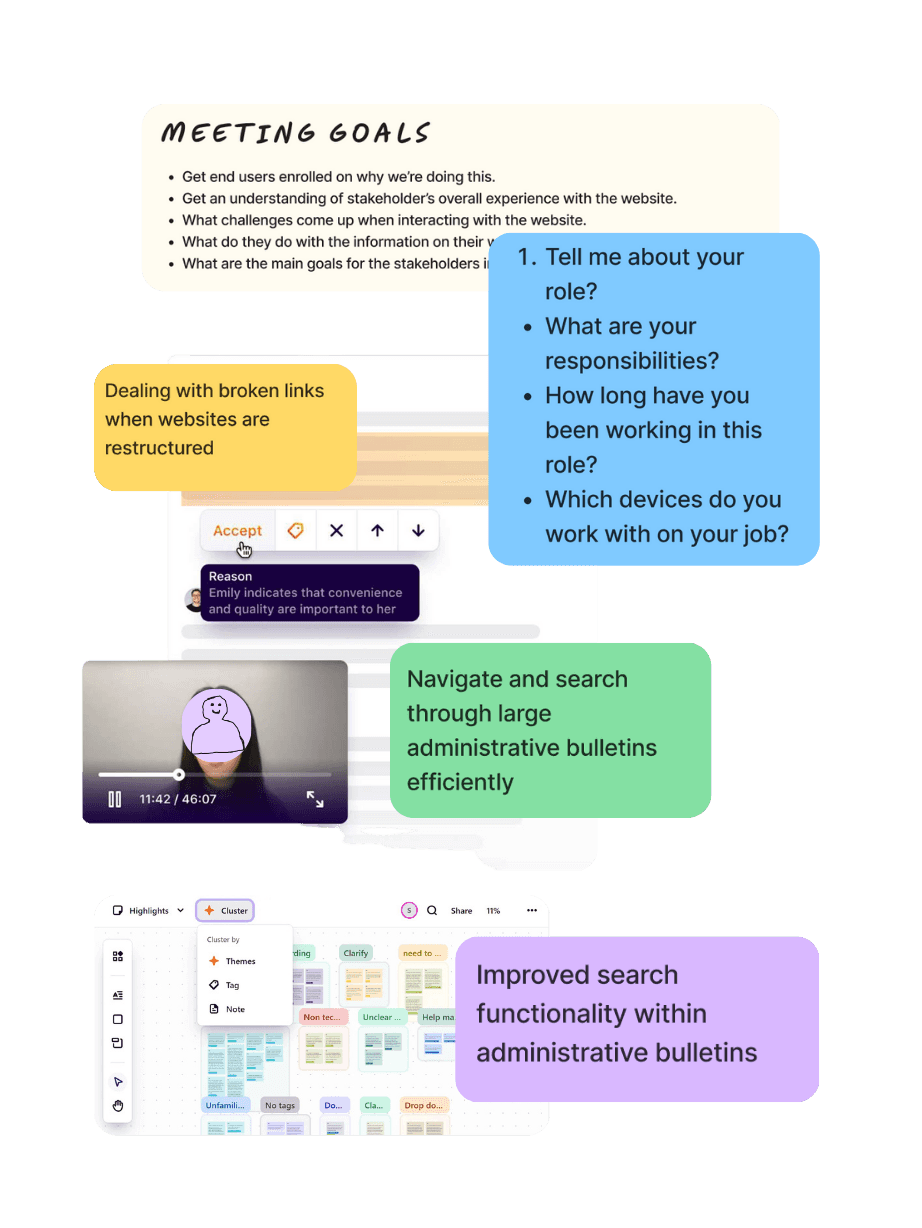
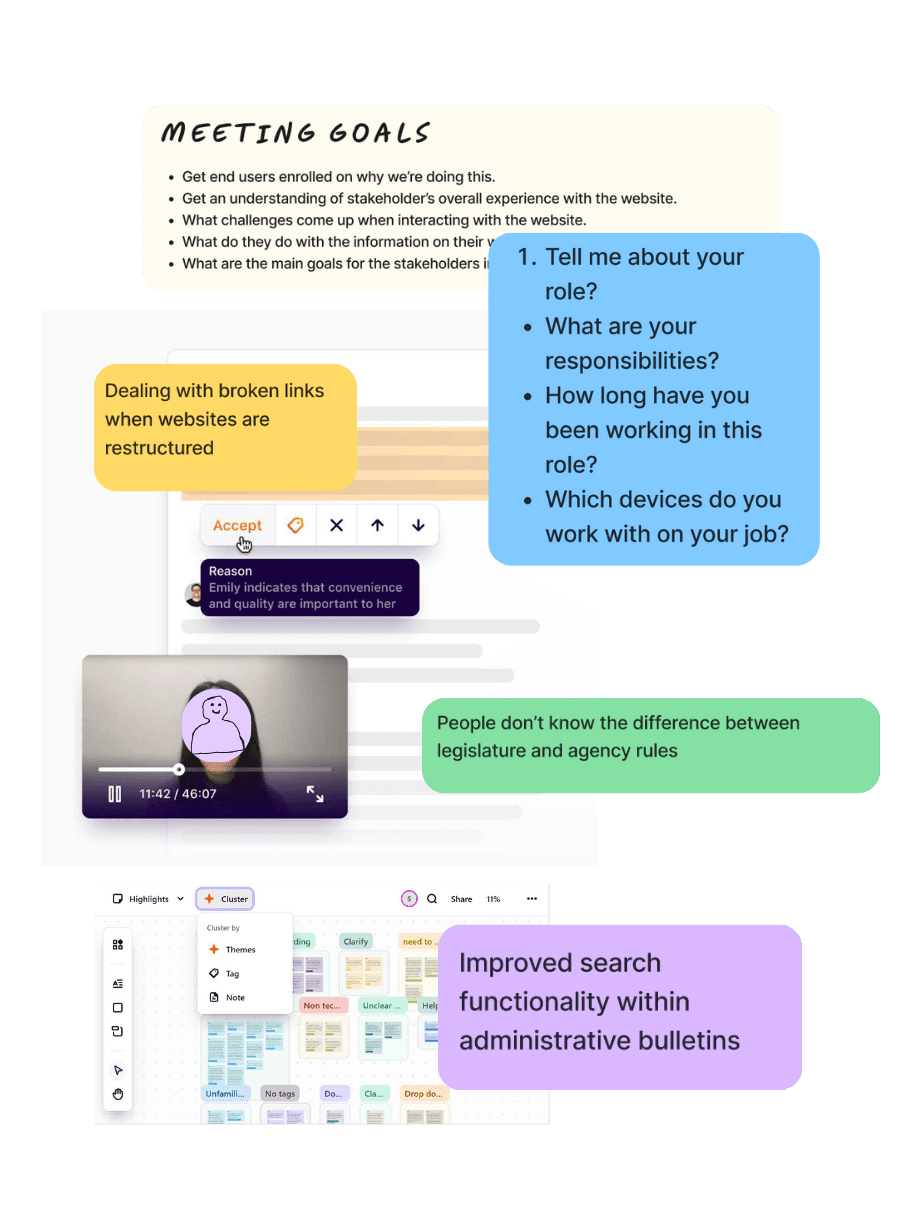
Before designing solutions, I focused on learning how people relied on the platform in real, time-sensitive situations. I spoke with users who used the site to research regulations, track changes, and explain rules to others.
These weren’t open-ended discovery conversations. They were about friction, urgency, and getting answers quickly.
A clear pattern emerged:
users didn’t come to explore.
They came with intent.
What was breaking the Experience
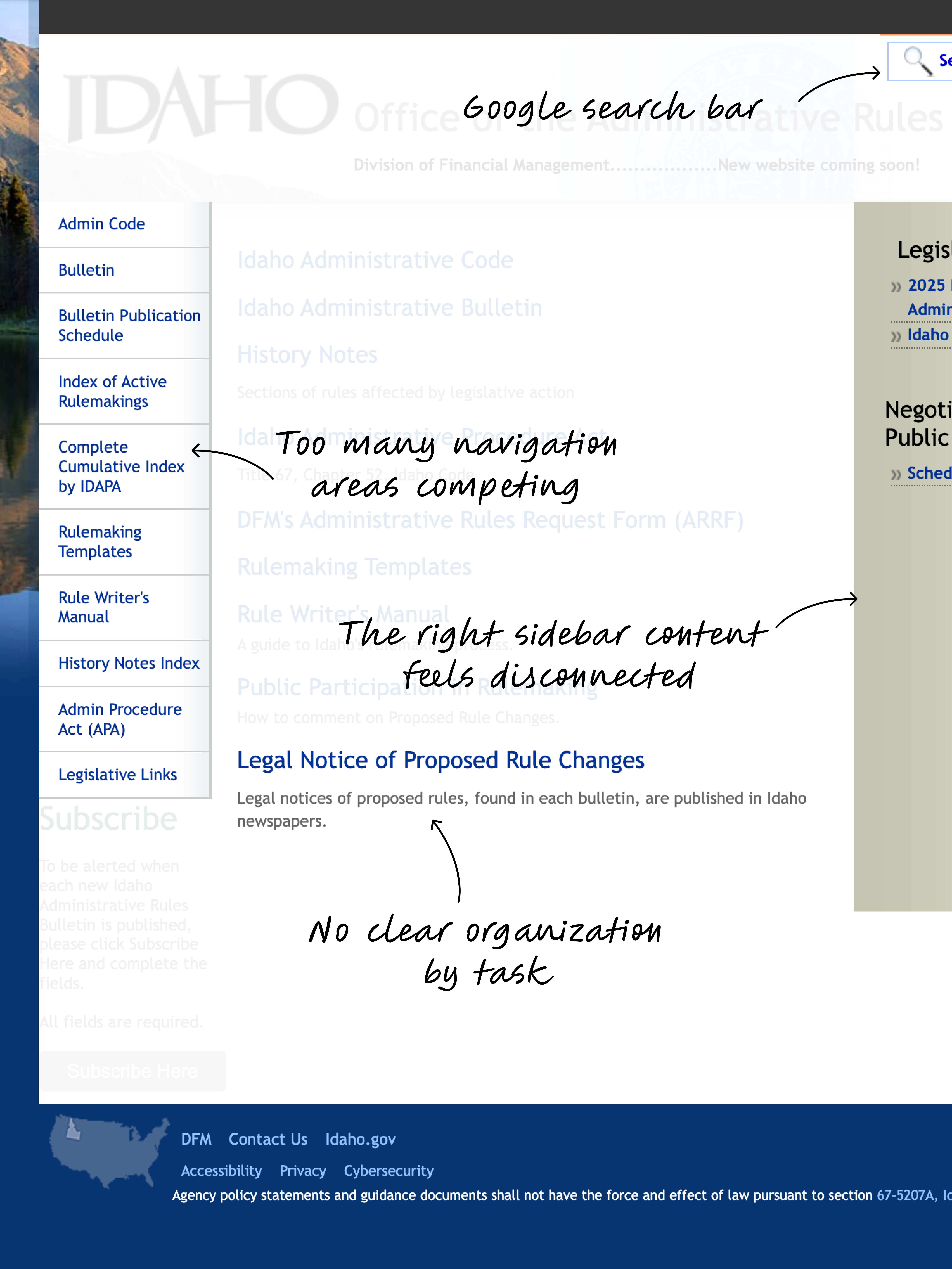
The takeaway was clear: complexity wasn’t the issue, exposure was.
Navigation worked against user intent
Content was organized by internal structure rather than user goals, making even simple tasks feel overwhelming.
Search lacked context
Rule history was hard to follow
the design shift
At this point, the direction of the project changed.
Instead of asking, “How do we redesign the website?”
I started asking, “How should someone move through this information?”
That shift shaped every decision that followed.
Design Strategy
Before moving forward, I aligned the work around three principles:
Clarity over completeness
Clarity over completeness
Users needed guidance, not everything at once.
Structure before visuals
Structure
before visuals
Information architecture had to work before UI polish.
Design for change
Design
for change
The system needed to support ongoing updates.
DESIGNING THE EXPERIENCE
At this point, the direction of the project changed.
Information Architecture
Rebuilding the Structure
The new IA reduced unnecessary depth and made relationships between current rules, archived rules, and supporting documents explicit. Users could now understand:
Where they were
What version they were viewing
How to move between related content
Without guessing.
Fig. Before and after: restructuring the website’s information architecture for clarity and usability.
Better navigation
The old site navigation relied on long text lists and a cluttered sidebar, making it difficult for users to locate key documents or understand where to start.
I, Introduced a clear top navigation bar that organize content by user intent, providing faster and easier access to essential resources.
Search was no longer treated as a fallback.
I designed a smarter search experience that allows users to search across years, agencies, and document types, without needing to know exact terminology.
To further reduce friction, I introduced an AI-powered assistant that supports natural language queries and explains rulemaking concepts in plain language.
Designing for Everyone (WCAG 2.1)
This platform wasn't just made to look better; it was made to be accessible to all Idahoans
Color & Contrast
I overhauled the color palette to meet AAA standards for readability.
I overhauled the color palette to meet AAA standards for readability.
Keyboard Navigation
Structure
before visuals
Added clear focus states and skip links for accessibility.
Added clear focus states and skip links for accessibility.
The Design System
Design
for change
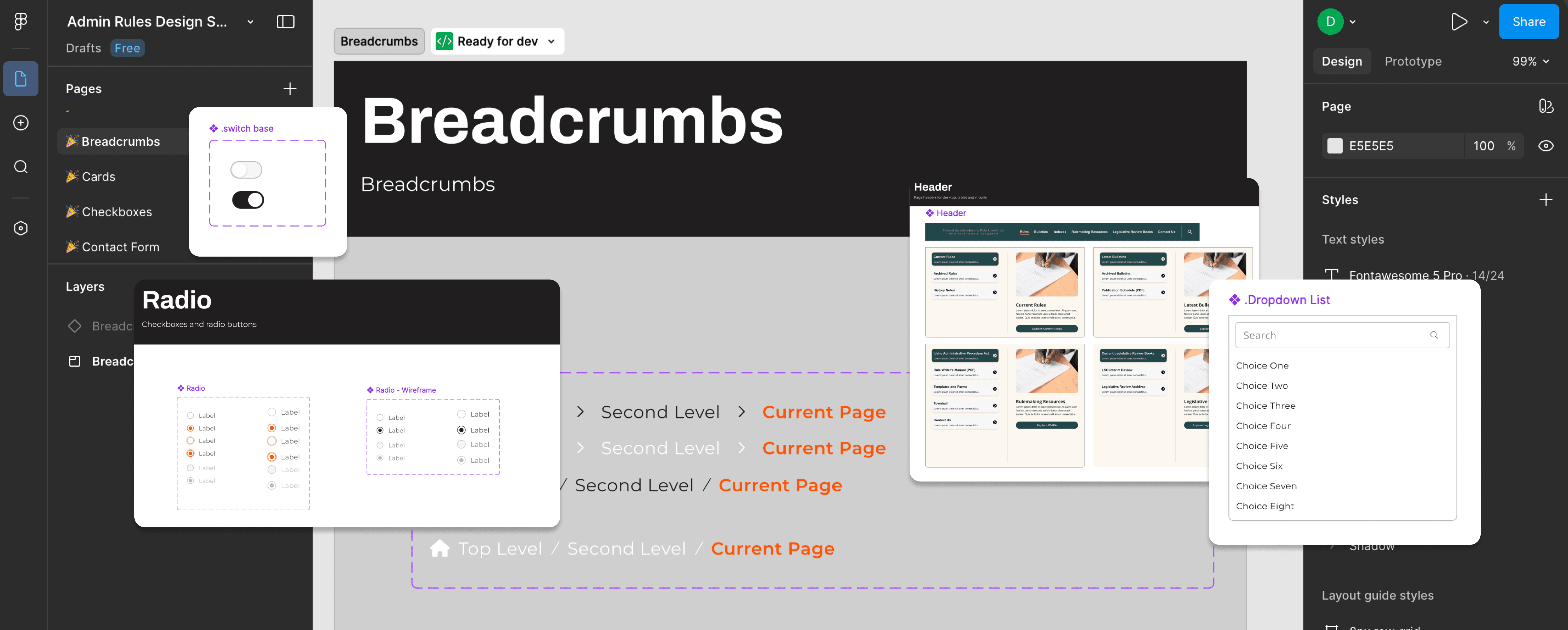
Built reusable, accessible, on-brand components for future DFM pages.
Built reusable, accessible, on-brand components for future DFM pages.
Validation
I tested the redesigned experience through multiple usability sessions, focusing on critical tasks like finding a new rule.
The difference was immediate.
Task: Find a New Rule
20%
20%
Old website success rate
100%
100%
Redesigned prototype success rate
More importantly, users felt confident. They knew where to start, and what to do next.
THE FINAL EXPERIENCE
The final design transformed the platform from a dense, text-heavy
system into a clear, approachable experience.
Users can now:
Find rules faster
Find rules faster
Understand historical context
Understand historical context
Navigate confidently without legal expertise
Navigate confidently without legal expertise
Delivery & Handoff
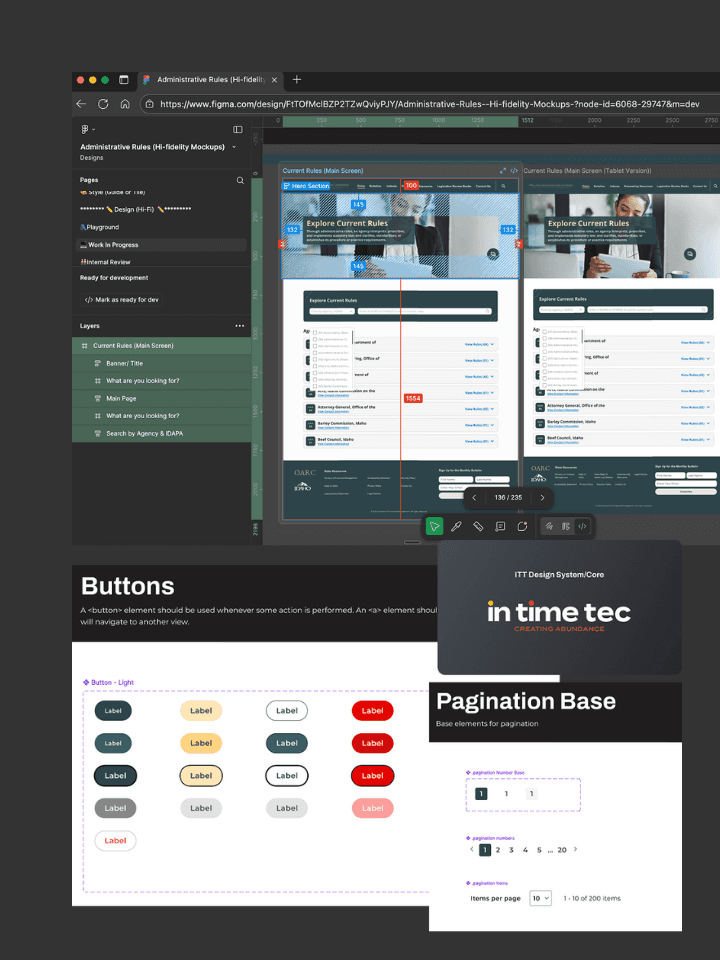
Because developers weren’t involved early, I focused heavily on clarity during handoff.
Each component was documented with behaviors and requirements, user stories were added in Azure DevOps, and the design system was adapted to ensure consistency and reusability.
The goal wasn’t just delivery, it was sustainability.
Key Lessons

Involve engineering earlier
Because developers weren't involved in the initial discovery, some early concepts had to be adjusted for technical feasibility. In future projects, I would advocate for "Triad" (Product, Design, Eng) alignment from Day 1.
Accessibility is a feature, not a checklist
Design for the Admin, not just the User
Thank you for reading! 🤍
More Projects
More Projects

A UX Case Study for the State of Idaho
Redesigning a State Government Platform for Clarity and Accessibility
Responsive Web Platform
|
Public Sector (B2B2C)
|
Nov 2024 - May 2025
I converted this 👇
I converted this 👇
To this 👇
To this 👇
My Role and Leadership
As the Lead Product Designer, I owned the end-to-end strategy and execution. Beyond the UI, my primary responsibility was Stakeholder Management, bridging the gap between the Division of Financial Management's legal requirements and the public's need for simplicity. I facilitated alignment workshops to define MVP features and established a developer-handoff framework in Azure DevOps to ensure high-fidelity implementation.
About the project
This project, for me, was about cutting through complexity and redesigning an outdated legal website into something people could navigate with confidence.
Tools Used
How do we simplify a highly regulated, legally complex system, without oversimplifying the law or adding new maintenance burden?
The PROBLEM
The site had become a blocker rather than a resource.
From a user perspective, finding a single rule often meant navigating through long lists of links, jumping between pages, and manually piecing together context from multiple documents.
From an internal perspective, the DFM team struggled to update and manage content. Simple changes required extra effort, slowing response times and increasing the risk of outdated information remaining live.
SOLUTION
Visual Clarity
Visual Clarity
Better Navigation
Better Navigation
Consistent Elements
Consistent Elements
Improved User Flow
Improved User Flow
Improved IA
Improved IA
Usability-Ready Prototype
Usability-Ready Prototype
Developer-Friendly Design System
Developer-Friendly Design System
Cross-Team Collaboration
Cross-Team Collaboration
Business objective
DFM needed a modern, reliable platform that made administrative rules easy to access, understand, and maintain
To improve public access to legally binding information and reduce internal operational friction, the Division of Financial Management partnered with our team to redesign the Administrative Rules website.
The goal was to create a clear, user-centered, and maintainable platform that supports frequent rule updates, builds trust with the public, and scales as regulations evolve.
RESEARCH CONTEXT
Understanding how the platform was actually used mattered more than how it was intended to work.
Before designing solutions, I focused on learning how people relied on the platform in real, time-sensitive situations. I spoke with users who used the site to research regulations, track changes, and explain rules to others.
These weren’t open-ended discovery conversations. They were about friction, urgency, and getting answers quickly.
A clear pattern emerged:
users didn’t come to explore.
They came with intent.
What was breaking the Experience
The takeaway was clear: complexity wasn’t the issue, exposure was.
Navigation worked against user intent
Content was organized by internal structure rather than user goals, making even simple tasks feel overwhelming.
Search lacked context
Rule history was hard to follow
the design shift
At this point, the direction of the project changed.
Instead of asking, “How do we redesign the website?”
I started asking, “How should someone move through this information?”
That shift shaped every decision that followed.
Design Strategy
Before moving forward, I aligned the work around three principles:
Clarity over completeness
Clarity over completeness
Users needed guidance, not everything at once.
Structure before visuals
Structure
before visuals
Information architecture had to work before UI polish.
Design for change
Design
for change
The system needed to support ongoing updates.
DESIGNING THE EXPERIENCE
At this point, the direction of the project changed.
Information Architecture
Rebuilding the Structure
The new IA reduced unnecessary depth and made relationships between current rules, archived rules, and supporting documents explicit. Users could now understand:
Where they were
What version they were viewing
How to move between related content
Without guessing.
Fig. Before and after: restructuring the website’s information architecture for clarity and usability.
Better navigation
The old site navigation relied on long text lists and a cluttered sidebar, making it difficult for users to locate key documents or understand where to start.
I, Introduced a clear top navigation bar that organize content by user intent, providing faster and easier access to essential resources.
Search was no longer treated as a fallback.
I designed a smarter search experience that allows users to search across years, agencies, and document types, without needing to know exact terminology.
To further reduce friction, I introduced an AI-powered assistant that supports natural language queries and explains rulemaking concepts in plain language.
Designing for Everyone (WCAG 2.1)
This platform wasn't just made to look better; it was made to be accessible to all Idahoans
Color & Contrast
I overhauled the color palette to meet AAA standards for readability.
I overhauled the color palette to meet AAA standards for readability.
Keyboard Navigation
Structure
before visuals
Added clear focus states and skip links for accessibility.
Added clear focus states and skip links for accessibility.
The Design System
Design
for change
Built reusable, accessible, on-brand components for future DFM pages.
Built reusable, accessible, on-brand components for future DFM pages.
Validation
I tested the redesigned experience through multiple usability sessions, focusing on critical tasks like finding a new rule.
The difference was immediate.
Task: Find a New Rule
20%
20%
Old website success rate
100%
100%
Redesigned prototype success rate
More importantly, users felt confident. They knew where to start, and what to do next.
THE FINAL EXPERIENCE
The final design transformed the platform from a dense, text-heavy
system into a clear, approachable experience.
Users can now:
Find rules faster
Find rules faster
Understand historical context
Understand historical context
Navigate confidently without legal expertise
Navigate confidently without legal expertise
Delivery & Handoff
Because developers weren’t involved early, I focused heavily on clarity during handoff.
Each component was documented with behaviors and requirements, user stories were added in Azure DevOps, and the design system was adapted to ensure consistency and reusability.
The goal wasn’t just delivery, it was sustainability.
Key Lessons
Involve engineering earlier
Because developers weren't involved in the initial discovery, some early concepts had to be adjusted for technical feasibility. In future projects, I would advocate for "Triad" (Product, Design, Eng) alignment from Day 1.
Accessibility is a feature, not a checklist
Design for the Admin, not just the User
Thank you for reading! 🤍
More Projects
More Projects
A UX Case Study for the State of Idaho
Redesigning a State Government Platform for Clarity and Accessibility
Responsive Web Platform
|
Public Sector (B2B2C)
|
Nov 2024 - May 2025
I converted this 👇
I converted this 👇
To this 👇
To this 👇
My Role and Leadership
As the Lead Product Designer, I owned the end-to-end strategy and execution. Beyond the UI, my primary responsibility was Stakeholder Management, bridging the gap between the Division of Financial Management's legal requirements and the public's need for simplicity. I facilitated alignment workshops to define MVP features and established a developer-handoff framework in Azure DevOps to ensure high-fidelity implementation.
About the project
This project, for me, was about cutting through complexity and redesigning an outdated legal website into something people could navigate with confidence.
Tools Used
How do we simplify a highly regulated, legally complex system, without oversimplifying the law or adding new maintenance burden?
The PROBLEM
The site had become a blocker rather than a resource.
From a user perspective, finding a single rule often meant navigating through long lists of links, jumping between pages, and manually piecing together context from multiple documents.
From an internal perspective, the DFM team struggled to update and manage content. Simple changes required extra effort, slowing response times and increasing the risk of outdated information remaining live.
SOLUTION
Visual Clarity
Visual Clarity
Better Navigation
Better Navigation
Consistent Elements
Consistent Elements
Improved User Flow
Improved User Flow
Improved IA
Improved IA
Usability-Ready Prototype
Usability-Ready Prototype
Developer-Friendly Design System
Developer-Friendly Design System
Cross-Team Collaboration
Cross-Team Collaboration
Business objective
DFM needed a modern, reliable platform that made administrative rules easy to access, understand, and maintain
To improve public access to legally binding information and reduce internal operational friction, the Division of Financial Management partnered with our team to redesign the Administrative Rules website.
The goal was to create a clear, user-centered, and maintainable platform that supports frequent rule updates, builds trust with the public, and scales as regulations evolve.
RESEARCH CONTEXT
Understanding how the platform was actually used mattered more than how it was intended to work.
Before designing solutions, I focused on learning how people relied on the platform in real, time-sensitive situations. I spoke with users who used the site to research regulations, track changes, and explain rules to others.
These weren’t open-ended discovery conversations. They were about friction, urgency, and getting answers quickly.
A clear pattern emerged:
users didn’t come to explore.
They came with intent.
What was breaking the Experience
The takeaway was clear: complexity wasn’t the issue, exposure was.
Navigation worked against user intent
Content was organized by internal structure rather than user goals, making even simple tasks feel overwhelming.
Search lacked context
Rule history was hard to follow
the design shift
At this point, the direction of the project changed.
Instead of asking, “How do we redesign the website?”
I started asking, “How should someone move through this information?”
That shift shaped every decision that followed.
Design Strategy
Before moving forward, I aligned the work around three principles:
Clarity over completeness
Clarity over completeness
Users needed guidance, not everything at once.
Structure before visuals
Structure
before visuals
Information architecture had to work before UI polish.
Design for change
Design
for change
The system needed to support ongoing updates.
DESIGNING THE EXPERIENCE
At this point, the direction of the project changed.
Information Architecture
Rebuilding the Structure
The new IA reduced unnecessary depth and made relationships between current rules, archived rules, and supporting documents explicit. Users could now understand:
Where they were
What version they were viewing
How to move between related content
Without guessing.
Fig. Before and after: restructuring the website’s information architecture for clarity and usability.
Better navigation
The old site navigation relied on long text lists and a cluttered sidebar, making it difficult for users to locate key documents or understand where to start.
I, Introduced a clear top navigation bar that organize content by user intent, providing faster and easier access to essential resources.
Search was no longer treated as a fallback.
I designed a smarter search experience that allows users to search across years, agencies, and document types, without needing to know exact terminology.
To further reduce friction, I introduced an AI-powered assistant that supports natural language queries and explains rulemaking concepts in plain language.
Designing for Everyone (WCAG 2.1)
This platform wasn't just made to look better; it was made to be accessible to all Idahoans
Color & Contrast
I overhauled the color palette to meet AAA standards for readability.
I overhauled the color palette to meet AAA standards for readability.
Keyboard Navigation
Structure
before visuals
Added clear focus states and skip links for accessibility.
Added clear focus states and skip links for accessibility.
The Design System
Design
for change
Built reusable, accessible, on-brand components for future DFM pages.
Built reusable, accessible, on-brand components for future DFM pages.
Validation
I tested the redesigned experience through multiple usability sessions, focusing on critical tasks like finding a new rule.
The difference was immediate.
Task: Find a New Rule
20%
20%
Old website success rate
100%
100%
Redesigned prototype success rate
More importantly, users felt confident. They knew where to start, and what to do next.
THE FINAL EXPERIENCE
The final design transformed the platform from a dense, text-heavy
system into a clear, approachable experience.
Users can now:
Find rules faster
Find rules faster
Understand historical context
Understand historical context
Navigate confidently without legal expertise
Navigate confidently without legal expertise
Delivery & Handoff
Because developers weren’t involved early, I focused heavily on clarity during handoff.
Each component was documented with behaviors and requirements, user stories were added in Azure DevOps, and the design system was adapted to ensure consistency and reusability.
The goal wasn’t just delivery, it was sustainability.
Key Lessons
Involve engineering earlier
Because developers weren't involved in the initial discovery, some early concepts had to be adjusted for technical feasibility. In future projects, I would advocate for "Triad" (Product, Design, Eng) alignment from Day 1.
Accessibility is a feature, not a checklist
Design for the Admin, not just the User